
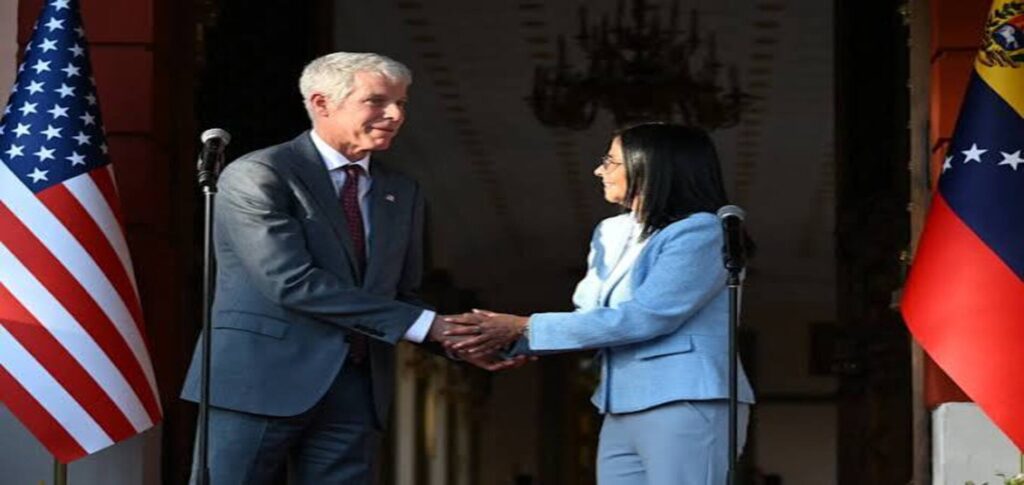
The United States has structured its position in a major Venezuelan oil venture to protect its 35% stake from dilution as the project raises new capital.
A U.S. official said the Pentagon used “penny warrants” to secure the position in North American Blue Energy Partners, or NABEP. The warrants give Washington the right, but not the obligation, to acquire equity later at a token price.
The arrangement is designed to protect the U.S. interest while NABEP raises the billions of dollars needed to develop its oil fields.
How the US Stake Works
The warrants serve as an anti-dilution mechanism.
In simple terms, Washington wants to retain the economic value of its 35% position even if NABEP issues new shares to raise money.
The U.S. official said the structure should allow the government to receive the full value of its 35% interest when the project reaches mature production.
Importantly, Washington can also receive dividends before it exercises the warrants.
That gives the United States economic benefits from the investment while protecting its position during the development phase.
NABEP Gets Rights to 17 Oil Fields
NABEP is controlled by Venezuelan businessman Alejandro Betancourt.
Under the agreement, the company received 100-year rights to operate 17 Venezuelan oil fields. The fields hold an estimated 65 billion barrels of reserves.
The concessions were awarded without a competitive bidding process. That decision has already attracted scrutiny from lawmakers and energy industry observers.
The broader agreement forms part of Washington’s effort to rebuild Venezuela’s struggling oil industry and increase U.S. influence over its energy sector.
Pentagon Gets Access to Venezuelan Oil
The US Venezuela oil deal also gives the Pentagon preferential access to part of NABEP’s future production.
The U.S. government has a separate right of first offer to purchase the company’s oil.
Under the arrangement, Washington can buy 20% of the production at a price based on production costs. The remaining output would be purchased at market prices.
That provision gives the United States another potential economic benefit from the project.
Billions Needed to Develop the Fields
Developing Venezuela’s oil fields will require substantial investment.
Much of the country’s energy infrastructure has deteriorated after years of economic crisis, sanctions and declining investment.
NABEP will therefore need to raise significant amounts of capital to expand production.
The anti-dilution structure allows the company to seek that financing without immediately reducing the U.S. government’s economic interest.
Betancourt’s Background Draws Scrutiny
The deal has also faced questions because of Betancourt’s business history.
U.S. and European authorities have investigated his past dealings. However, he has not been charged and has denied wrongdoing.
U.S. officials have defended the arrangement and said Betancourt underwent government vetting.
They have described the agreement as part of a broader strategy to reshape Venezuela’s energy industry and strengthen U.S. interests in the country.
Venezuela Hopes to Increase Oil Output
Venezuela currently produces roughly 1.1 million to 1.2 million barrels of oil per day, according to the information cited in the deal’s rollout.
U.S. Energy Secretary Chris Wright has said production could more than double in the coming years if new investments move forward.
Several other agreements with international energy companies could also contribute to higher output.
Those companies include Chevron, Eni, ONGC, GeoPark and GE Vernova.
Questions Over Transparency Remain
Despite the potential economic benefits, the agreement continues to face political and legal scrutiny.
Critics have questioned the lack of competitive bidding and the role of the U.S. government in selecting private-sector partners.
Energy companies have also expressed concerns about competing with a venture backed by the U.S. government.
Meanwhile, lawmakers have demanded more information about the contracts and the financial structure behind the deal.
Pentagon Sets Rules Over Cerberus Links
The Pentagon has also introduced safeguards involving officials with previous ties to Cerberus Capital Management.
The private equity firm is not involved in the Venezuela oil agreement. However, Deputy Secretary of Defense Steve Feinberg previously co-founded Cerberus.
Under the Pentagon’s rules, officials who previously worked for Cerberus must recuse themselves from transactions involving the firm’s assets.
Such matters must instead go to Commerce Secretary Howard Lutnick for review and approval.
Lawmakers have called for greater separation between former Cerberus officials and government procurement decisions.
US Venezuela Oil Deal Faces a Major Test
The US Venezuela oil deal gives Washington a powerful position in one of the world’s largest oil-producing countries.
However, turning that position into actual production will take time and billions of dollars in investment.
The penny warrants protect the U.S. stake while NABEP develops the fields and raises additional capital.
Now, the bigger test will be whether the venture can successfully increase Venezuelan oil production while overcoming infrastructure, political and legal challenges.
For Washington, protecting its 35% position is only the first step. The real challenge will be turning that stake into lasting economic and strategic value.