
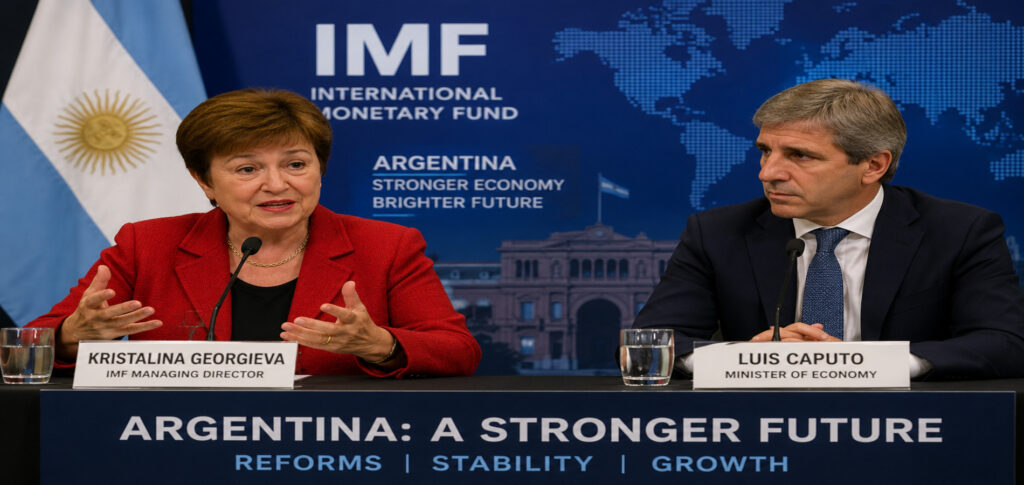
International Monetary Fund (IMF) Managing Director Kristalina Georgieva has praised Argentina’s economic reforms under President Javier Milei, saying the country is now in a much stronger position to meet its future debt obligations.
Speaking during a visit to Buenos Aires, Georgieva credited the government’s fiscal discipline and sweeping economic reforms with restoring investor confidence in one of the world’s most heavily indebted nations.
IMF Sees Major Economic Improvement
Argentina remains the IMF’s largest borrower, with approximately $58 billion in outstanding loans.
Despite the country’s long history of debt defaults, Georgieva said the situation has changed significantly.
She noted that when she became IMF managing director in 2019, discussions centered on whether Argentina could continue servicing its debts.
Today, she said, that is no longer the primary concern.
“Argentina is in a much stronger position, and this is the result of the government’s hard work and the perseverance and sacrifice of the Argentine people,” Georgieva said.
Market Confidence Returns
The IMF chief highlighted several positive economic developments that have improved Argentina’s financial outlook.
These include:
- Falling inflation
- Higher foreign exchange reserves
- Rising government bond prices
- Improved sovereign credit ratings
Annual inflation has reportedly fallen to around 33%, compared with approximately 210% when President Milei took office in late 2023.
Credit rating agencies, including Moody’s, S&P, and Fitch, have also upgraded Argentina’s sovereign rating in recent months.
According to Georgieva, these improvements have helped rebuild confidence among international investors.
Debt Repayments Begin Next Year
Argentina is expected to begin repaying principal on its IMF loans starting in 2027, making the coming years crucial for the country’s financial stability.
Economy Minister Luis Caputo has said the government plans to finance repayments through:
- Support from international lenders
- Privatization proceeds
- Domestic borrowing
Officials have indicated they are not relying on a return to global financial markets at this stage.
Georgieva also stated she does not expect additional IMF disbursements before Argentina’s next presidential election.
Energy Sector Seen as Key Growth Driver
During her visit, Georgieva is also scheduled to tour Vaca Muerta, one of the world’s largest unconventional oil and natural gas reserves.
The massive energy project is expected to become one of Argentina’s biggest sources of foreign currency earnings over the coming years and could play an important role in strengthening public finances.
Challenges Still Remain
Despite improving economic indicators, Argentina continues to face significant domestic challenges.
The government’s strict austerity measures have coincided with:
- Weak consumer spending
- Sluggish wage growth
- Higher household debt
- Slightly rising unemployment
President Milei’s approval ratings have declined, raising questions about whether his reform agenda would continue beyond the next election.
Georgieva acknowledged these political uncertainties but stressed that maintaining strong economic policies is essential to sustaining investor confidence.
IMF Calls for Continued Reforms
While praising recent progress, the IMF chief said Argentina still needs further reforms in several key areas.
These include:
- Expanding access to business and mortgage credit
- Boosting construction activity
- Reducing informal employment
- Strengthening long-term economic stability
Georgieva concluded that Argentina now has an opportunity to become one of the countries that successfully borrowed from the IMF, implemented reforms, stabilized its economy, and ultimately no longer required financial assistance.