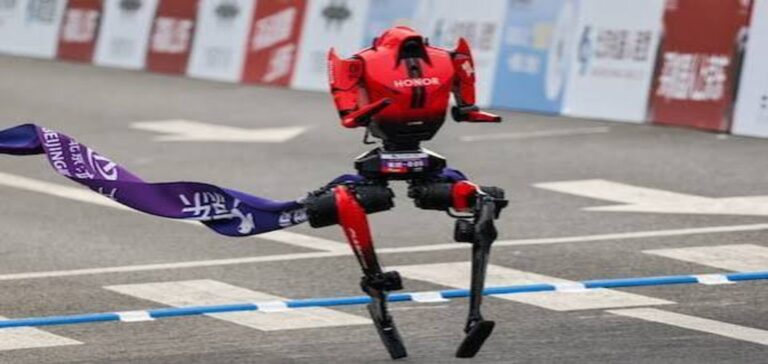

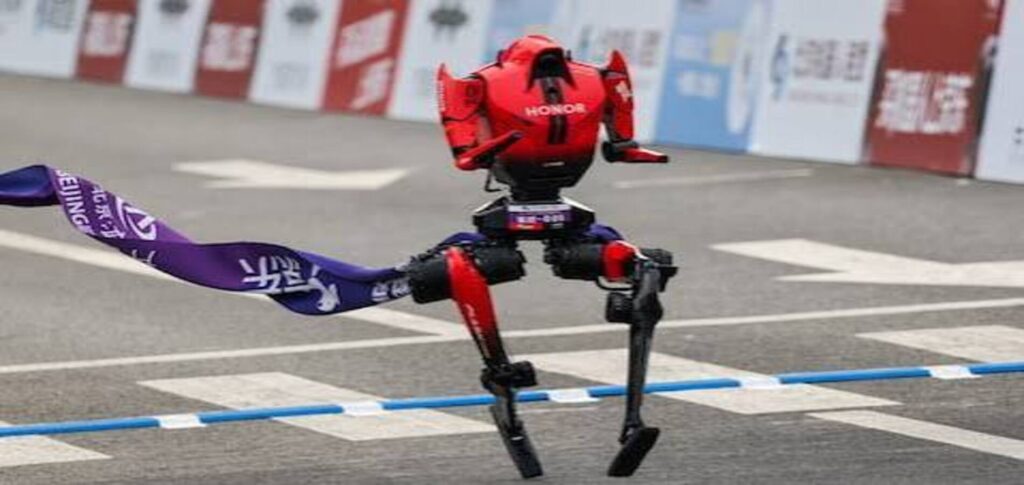
A Chinese robot 100m record test has drawn global attention after a humanoid machine called Lightning completed the distance in 9.32 seconds, according to China’s state broadcaster.
The robot’s time beats Jamaican sprinting legend Usain Bolt’s human 100-meter world record of 9.58 seconds. Bolt set that record at the 2009 World Athletics Championships in Berlin.
However, Lightning’s performance does not replace Bolt’s official athletics record. The robot competed outside human track-and-field rules. Its faster time instead highlights the rapid development of humanoid robotics.
Lightning Reaches 14.5 Meters Per Second
Lightning reached a reported top speed of 14.5 meters per second during a preparatory event in Beijing.
The test took place ahead of the second World Humanoid Robot Games, which opened in the Chinese capital on Saturday.
The machine stands around 169 centimeters tall. Researchers have also increased its leg length as they prepare it for further competitions.
China has placed humanoid robots high on its technology agenda. Companies and policymakers hope advances in artificial intelligence, robotics and hardware will move these machines into factories, warehouses and consumer environments.
Robot Also Won Beijing Half Marathon
Lightning has already attracted attention beyond the 100-meter test.
In April, the robot reportedly won a 21-kilometer Beijing half marathon in 50 minutes and 26 seconds. That performance also exceeded the pace required to match the elite men’s world-record time.
Researchers have since modified Lightning ahead of the robot games. They increased its leg length by about 10 centimeters, bringing it to roughly 1.05 meters.
The changes could help the robot improve stability, stride length and overall running performance.
Robots Push the Limits of Speed
The Chinese robot 100m record test shows how quickly engineers are developing machines that can perform complex physical movements.
Unlike human athletes, robots do not face the same biological limits. Engineers can modify their motors, batteries, joints, software and body design to improve performance.
Still, speed alone does not determine how useful a humanoid robot will become. Developers must also improve balance, energy efficiency, reliability and autonomous movement.
Lightning’s latest run therefore offers more than a striking comparison with Bolt. It also demonstrates how China is using humanoid robot competitions to showcase advances in AI and robotics.