

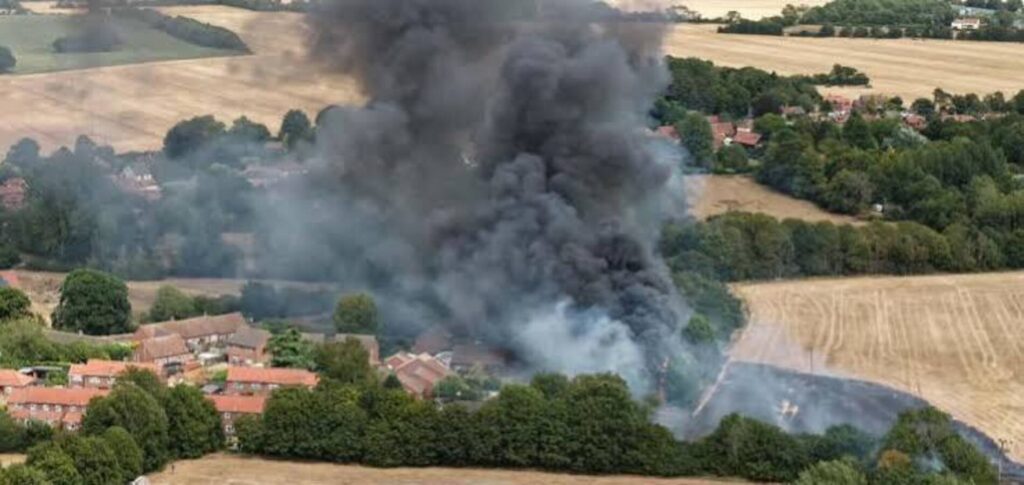
A foil balloon fire has been identified as the likely cause of a blaze that destroyed homes in Kenninghall, Norfolk, earlier this month.
UK Power Networks (UKPN) said an independent forensic investigation linked the fire to a foil-coated helium balloon that came into contact with overhead power lines.
The investigation found debris on equipment attached to a power pole in a field beside homes on Wood Close. Investigators believe the balloon caused an electrical arc after touching the overhead line.
The arc then ignited the balloon. Strong, dry and windy conditions likely helped the burning material fall to the ground and start the field fire.
Family Left Without Their Home
Siobhan Fulcher lost the home where she had lived for 12 years. She and her 33-year-old son, Aaron, now live in temporary accommodation.
Fulcher said she felt “shocked and disappointed” by the findings. She also said she wanted further answers about what happened.
The fire broke out on 9 August and quickly spread across the dry field before reaching neighbouring properties.
Norfolk Fire and Rescue Service initially described the blaze as accidental. The service said a fault involving a power transformer had caused sparks to land on dry ground and ignite the vegetation.
UK Power Networks Responds
UK Power Networks said its own equipment did not have any faults or issues.
The company said crews attended the site after a request from the fire service. Workers also de-energised the local network as a safety measure while the fire burned.
UKPN described the incident as rare and expressed sympathy for the families affected.
The independent investigator reached a different conclusion from the initial assessment. The investigation identified a third-party foil-coated helium balloon as the most likely source of the ignition.
The balloon reportedly came into contact with an overhead power line. This created an electrical arc that ignited the balloon before it fell into the field.
Warning Over Helium Balloons
An electrical arc occurs when an electric current travels outside its normal conductive path. In this case, the contact between the balloon and the power line created the conditions needed to start the fire.
Foil balloons have caused similar incidents elsewhere in the UK.
In July, a children’s balloon started a field fire in Tithby, Nottinghamshire, after it came into contact with a pylon.
Nottinghamshire Fire and Rescue Service subsequently warned people never to deliberately release helium balloons. Such balloons can cause power outages and also pose risks to wildlife and livestock.
The service advised people to deflate balloons before disposing of them.
The Kenninghall fire has renewed concerns about the dangers posed by balloons near overhead electricity lines, particularly during hot, dry and windy weather.