
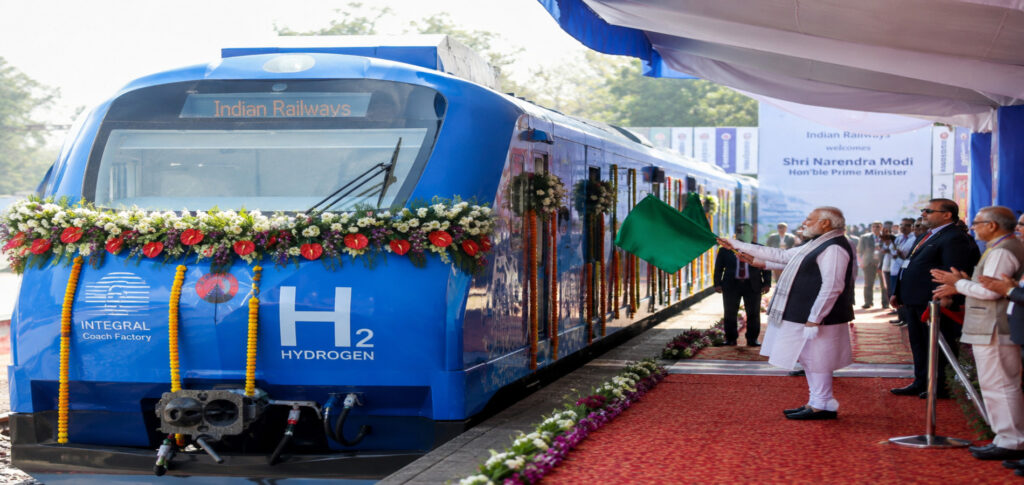
India Launches First Hydrogen-Powered Train as the country takes another major step toward cleaner transportation, becoming one of a handful of nations using hydrogen technology to reduce emissions from rail travel. Prime Minister Narendra Modi flagged off the inaugural service on Friday, calling it a milestone in India’s journey toward sustainable development and technological self-reliance.
“This is a very significant day in the direction of self-reliant India and sustainable development,” Modi wrote in a post on social media.
The launch places India alongside Germany, Japan, China and the United States, all of which have introduced or tested hydrogen-powered trains as part of their clean-energy strategies.
India Launches First Hydrogen-Powered Train on Haryana Route
The new hydrogen-powered train will run on an 89-kilometre route between Jind and Sonipat in Haryana.
The train features 10 coaches and uses a 1,200-kilowatt hydrogen fuel cell system, which Indian railway officials describe as the most powerful hydrogen-powered passenger train system developed for rail transport.
Unlike diesel engines, hydrogen fuel cells generate electricity by combining hydrogen with oxygen. As a result, the train produces only water and steam, making it a far cleaner alternative for passenger rail services.
India launched the project to lower carbon emissions while modernising one of the world’s busiest railway networks.
Pilot Project Opens a New Chapter
The Ministry of Railways said Indian engineers developed the hydrogen-powered train, although officials acknowledged they imported several critical components, including the hydrogen fuel cells.
Authorities also inaugurated a hydrogen storage and refuelling facility in Jind capable of storing around 3,000 kilograms of hydrogen. The facility will support future hydrogen-powered rail operations as the technology expands across the country.
Railway officials estimate the pilot project cost around $12 million, making it significantly more expensive than a conventional train service.
However, officials expect costs to decline as hydrogen production expands, technology improves and local manufacturing increases.
Indian Railways Continues Modernisation Drive
The launch marks another milestone in the continuing transformation of Indian Railways.
From the country’s first passenger steam train in 1853, the railway network has grown into one of the largest and busiest systems in the world.
According to official figures, Indian Railways carried 7.41 billion passengers and transported 1.67 billion tonnes of freight during the past year.
The government has invested heavily in upgrading tracks, improving safety standards and introducing faster trains. One of its flagship projects is the Vande Bharat Express, which can reach speeds of up to 180 kilometres per hour.
India is also building its first high-speed rail corridor using Japan’s famous Shinkansen technology. The new bullet train will reach speeds of up to 320 kilometres per hour, with the first section expected to begin operations in 2027.
Hydrogen Technology Could Shape India’s Rail Future
Although the hydrogen-powered train currently operates as a pilot project, officials believe it represents an important step toward cleaner rail transportation.
If the trial proves successful, India could gradually introduce additional hydrogen-powered services, helping reduce carbon emissions while strengthening energy security and supporting long-term environmental goals.
The project also demonstrates India’s ambition to become a global leader in sustainable transport technology while continuing to modernise one of the world’s most important railway networks.