
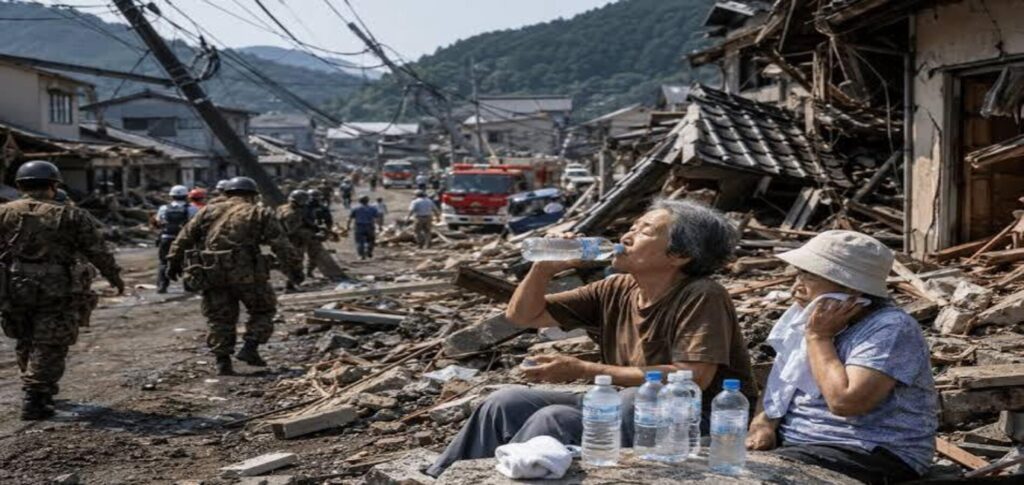
Japan quake rescue efforts continue after a powerful 7.1-magnitude earthquake killed at least 25 people in southern Japan, leaving thousands without water, electricity and shelter as extreme summer heat worsens conditions.
Japan Quake Leaves Thousands Without Basic Services
The Japan quake severely damaged homes, roads, and underground infrastructure in the city of Yatsushiro, where around 58,000 households continue to face major disruptions.
Local officials confirmed that broken water pipelines have left entire neighborhoods without clean drinking water, while electricity outages continue across the affected region.
Emergency toilets have been installed outside government buildings as officials work to restore essential services.
Japan Quake Leaves Thousands Without Water
Authorities say the lack of clean water has become one of the biggest challenges following the disaster.
Temperatures have remained around 35°C (95°F), with forecasts predicting they could approach 40°C over the coming days, increasing the risk of heat-related illnesses.
Military water tankers have been deployed to supply residents, but water distribution remains limited as repair crews work around the clock.
Death Toll Continues to Increase
The official death toll from the Japan quake has climbed to 25, with most fatalities reported at:
- A damaged paper manufacturing plant
- A shopping mall where a suspected gas explosion occurred
Officials are also investigating several additional deaths to determine whether they were directly linked to the earthquake.
Among the victims was a Vietnamese factory worker whose story has drawn widespread attention after his wife revealed their final video call took place just hours before the earthquake struck.
Rescue and Recovery Efforts Continue
Japan’s Self-Defense Forces have intensified emergency operations by:
- Delivering clean drinking water
- Installing hundreds of air-conditioning units at evacuation centers
- Supporting search-and-rescue operations
- Assisting damaged communities with emergency supplies
Officials say restoring damaged water infrastructure could take weeks or even months because of the extensive destruction beneath city streets.
Major Manufacturers Suspend Production
The earthquake has also disrupted Japan’s manufacturing industry.
Several major companies have temporarily suspended operations, including:
- Toyota
- Honda
- Nissan
- Sony
- Aisin
Taiwan Semiconductor Manufacturing Company (TSMC) also briefly halted operations to inspect facilities after the tremor.
The Japanese government is monitoring potential disruptions to global supply chains, particularly in the automotive and semiconductor industries.
Japan Remains Vulnerable to Major Earthquakes
Japan lies along the Pacific Ring of Fire, one of the world’s most active seismic zones.
Although strict building regulations and disaster preparedness have helped reduce casualties over the years, powerful earthquakes continue to pose serious risks to communities and critical infrastructure.
Authorities say immediate priorities remain restoring water, electricity, transportation, and protecting evacuees from dangerous summer temperatures.