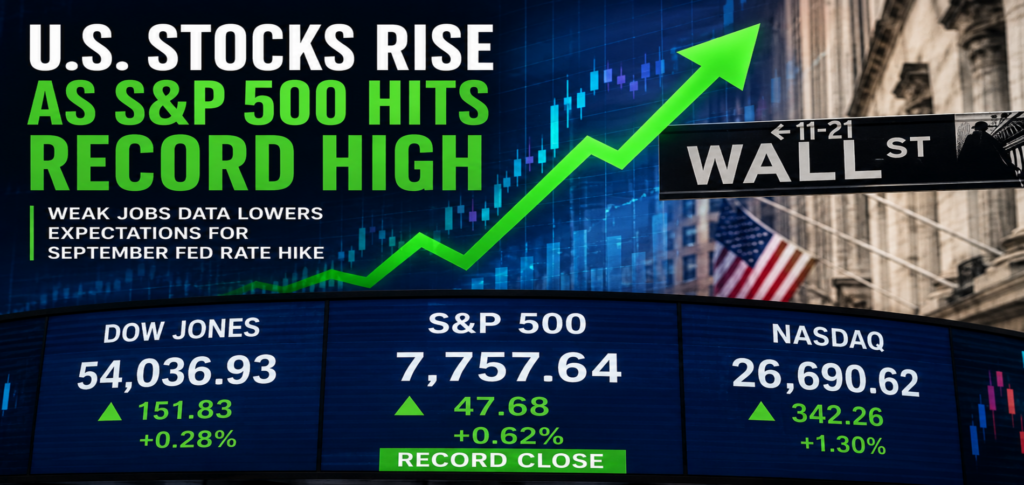
U.S. stocks ended higher on Friday, with the S&P 500 reaching a record closing level after unexpectedly weak U.S. jobs data reduced expectations for another Federal Reserve rate hike in September.
The Labor Department reported that nonfarm payrolls fell by 23,000 last month. Economists surveyed by Reuters had expected an increase of about 80,000 jobs.
The report also showed significant downward revisions to employment gains recorded during the previous two months. The unemployment rate fell slightly to 4.1% from 4.2%, partly because some workers left the labor force.
Fed Rate Hike Expectations Fall
The weaker employment figures quickly changed expectations for Federal Reserve policy.
According to CME FedWatch, market expectations for a September rate hike fell to about 44%, compared with 55% in the previous session and 67% a week earlier.
Investors have been closely watching economic data as the Federal Reserve provides limited forward guidance on monetary policy under new Fed Chair Kevin Warsh.
The latest jobs figures strengthened expectations that policymakers could face pressure to support the labor market.
S&P 500 Reaches Record Close
The major U.S. stock indexes all finished higher.
The Dow Jones Industrial Average gained 151.83 points, or 0.28%, to close at 54,036.93.
The S&P 500 advanced 47.68 points, or 0.62%, to 7,757.64, marking a record closing high.
The Nasdaq Composite climbed 342.26 points, or 1.30%, to 26,690.62.
The gains capped a strong week for U.S. stocks. The S&P 500 rose 3.58% for the week, while the Nasdaq gained 5.19%. The Dow advanced 2.96%.
Earnings Give Markets Another Boost
Strong corporate earnings also helped support the rally.
Of the 436 companies in the S&P 500 that had reported results through Friday morning, 85.1% had exceeded analyst expectations, according to LSEG data.
That figure is well above the long-term average of 68% since 1994.
Investors have also become less concerned about the huge spending by artificial intelligence companies as corporate earnings continue to show strength.
Tom Siomades, chief market economist at AE Wealth Management, said the market faces a difficult economic balance between supporting employment and controlling inflation.
He noted that lower interest rates could encourage job growth but could also increase inflationary pressure.
Oil Prices Ease as Iran Peace Prospects Grow
Signs of progress toward a potential peace agreement in the Iran war have also influenced markets.
Oil prices have cooled, helping ease concerns about inflation. Lower energy prices could reduce pressure on the Federal Reserve to keep interest rates higher.
The combination of weaker employment data, lower oil prices and strong corporate earnings helped push Treasury yields lower and supported the stock market.
SpaceX, Atlassian and Airbnb Among Biggest Movers
Several companies posted major gains during Friday’s session.
SpaceX surged 15.8% after the expiration of the first of several share lockup restrictions following its record public offering in June.
Atlassian jumped 35.3%, its biggest one-day percentage gain on record, after the collaboration software company forecast quarterly revenue above analysts’ expectations.
Microchip Technology rose 13.9%, marking its strongest daily performance in more than 15 months after giving an upbeat revenue outlook.
Airbnb gained 17.4% after reporting second-quarter revenue above expectations, making it the strongest performer on the S&P 500.
Trade Desk moved in the opposite direction, plunging 21.9% after the advertising technology company issued a weaker-than-expected third-quarter revenue forecast.
U.S. Stocks Finish Week Strongly
Market breadth remained positive, with advancing shares outnumbering declining stocks by 2.49 to 1 on the New York Stock Exchange and 2.07 to 1 on the Nasdaq.
The S&P 500 recorded nine new 52-week highs and one new low. The Nasdaq Composite recorded 123 new highs and 77 new lows.
Trading volume reached 16.94 billion shares, compared with an average of 17.56 billion shares over the previous 20 trading sessions.
With the latest gains, U.S. stocks enter the next week with strong momentum as investors continue to assess employment data, corporate earnings and the Federal Reserve’s next interest-rate decision.