

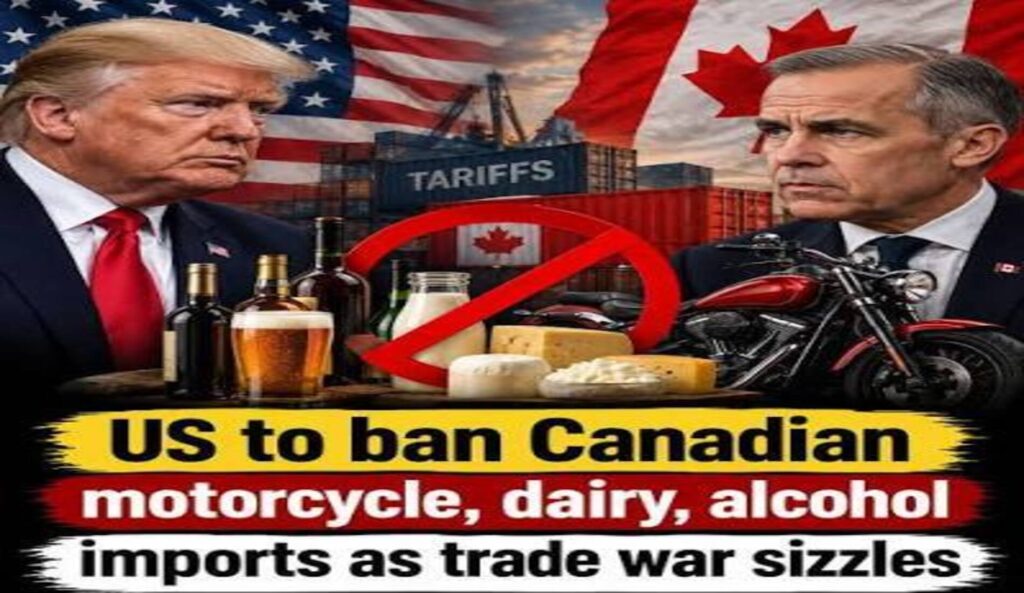
The US Canada trade war has entered a new phase after Washington announced bans on several Canadian imports.
The United States will block imports of a broad range of Canadian alcoholic drinks, motorcycles and dairy products from September 29.
The latest move came after Canada imposed retaliatory tariffs on about $20 billion worth of US goods. The measures have further strained relations between the two longtime allies.
US Canada Trade War Targets More Products
The new US measures go beyond traditional tariffs.
The bans cover many Canadian alcoholic beverages, including beer, wine, whisky, bourbon, rum, vodka, vermouth, tequila, mezcal and brandy.
Several dairy-related products will also face restrictions. These include whey products and certain molasses products.
Motorcycles are also among the targeted imports.
Meanwhile, the United States has added various Canadian cheese products to a list facing a 50% tariff instead of an outright ban.
Other products added to the tariff list include paper, aluminum, wood, furniture and lighting goods.
Canada Responds With Retaliatory Tariffs
Canada’s countermeasures took effect shortly before Washington announced the latest bans.
Ottawa imposed tariffs ranging from 15% to 50% on roughly $20 billion of US products.
The measures target goods including steel, furniture, clothing and electronics.
Canadian officials say the tariffs aim to increase pressure on Washington while protecting Canadian workers and businesses.
Prime Minister Mark Carney has also urged Canada to reduce its economic dependence on the United States.
He said Canada has the resources and ability to diversify its economic relationships.
Trump Keeps Pressure on Canada
President Donald Trump has continued to threaten further action against Canada.
A US official said Trump’s existing threat to raise tariffs on Canadian automobiles from 25% to 50% on January 1 remains in place.
Trump has also targeted Canadian aircraft manufacturer Bombardier.
He said the company could lose access to the US market unless it increases manufacturing in the United States.
In addition, Trump directed the General Services Administration to remove Canadian-origin products from certain federal purchasing schedules unless Canada restores what his administration considers fair trade treatment.
USMCA Faces Fresh Uncertainty
The escalating US Canada trade war has also raised concerns about the future of the US-Mexico-Canada Agreement.
The USMCA has supported trade between the three North American economies for years.
However, repeated tariff increases and retaliatory measures are creating uncertainty for businesses and investors.
Analysts have warned that continued escalation could disrupt supply chains and increase pressure on companies operating across the border.
Canadian Businesses Face Growing Pressure
The latest restrictions could affect Canadian producers that rely heavily on US consumers.
Canada has sent a large share of its exports to the United States this year, making the American market especially important to Canadian businesses.
The dispute has already affected sectors ranging from food and beverages to manufacturing.
Sapporo, which owns Ontario-based Sleeman Breweries, is considering shifting some production of non-alcoholic drinks from Canada to the United States because of tariff risks.
However, the company has not made a final decision.
Trade War Could Hit Both Economies
Although the latest measures cover a relatively small portion of total US-Canada trade, their wider economic impact could be significant.
Businesses face greater uncertainty over costs, supply chains and future investment.
Consumers could also face fewer choices and higher prices if the dispute continues.
At the same time, Canada remains closely linked to the US economy, making a prolonged confrontation difficult for both sides.
Washington and Ottawa Leave Door Open
Despite the sharp escalation, officials from both countries continue to discuss a possible way forward.
US Trade Representative Jamieson Greer has been in contact with Canada’s Dominic LeBlanc.
Both sides have indicated that further discussions could take place in the coming days.
However, the latest import bans show how quickly the dispute is expanding.
For now, the US Canada trade war remains a major challenge for North American trade, with businesses watching closely for signs of a negotiated solution.