

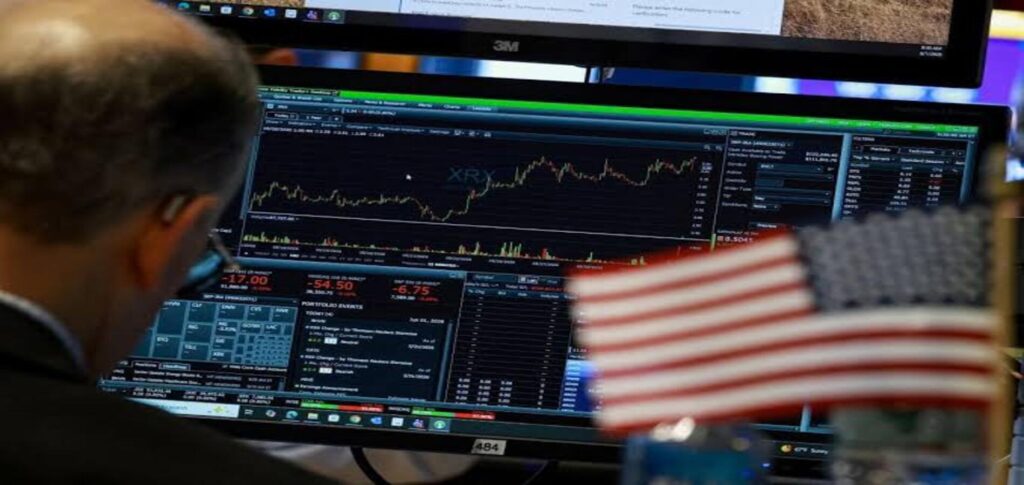
Wall Street stocks fell on Friday after a stronger-than-expected U.S. jobs report changed expectations for Federal Reserve policy.
The U.S. economy added 162,000 jobs in August, according to the Labor Department. Economists surveyed by Reuters had expected an increase of just 56,000 jobs.
The unemployment rate remained at 4.1%, matching economists’ expectations.
The stronger labor market could give the Federal Reserve more room to keep interest rates higher as officials focus on inflation.
Fed Chair Kevin Warsh has indicated that controlling price pressures remains a key priority for the central bank.
“This is obviously a very volatile report, but it does mean that at this point the Fed’s focus is going to be on inflation,” said Josh Stevens, chief investment officer at CresAlta Investment Management.
Traders raise rate hike bets
The jobs data quickly changed market expectations for the Fed’s next policy decision.
Short-term interest-rate futures showed a 60% chance of a rate increase at the Fed’s September 15-16 meeting. The probability stood at 55% before the jobs report.
“The market just had a knee-jerk reaction to the jobs report. Investors are shooting first and asking questions later,” said Thomas Hayes, chairman at Great Hill Capital.
By 11:52 a.m. ET, the major U.S. indexes were trading lower.
The Dow Jones Industrial Average fell 305.54 points, or 0.57%, to 53,380.57.
The S&P 500 dropped 33.99 points, or 0.44%, to 7,713.72.
The Nasdaq Composite declined 114.87 points, or 0.43%, to 26,469.19.
The declines capped a volatile week for U.S. markets. Investors adjusted their expectations as economic data, corporate earnings and comments from Fed officials changed the outlook for interest rates.
Investors await inflation data
Attention now turns to next week’s inflation reports.
The Labor Department will release its latest Consumer Price Index (CPI) and Producer Price Index (PPI) figures. The reports could influence the Fed’s decision at its September meeting.
A stronger jobs market could increase pressure on policymakers to keep inflation under control before making changes to interest rates.
Markets will therefore watch the upcoming inflation data closely.
Utilities gain as consumer stocks fall
Market performance varied across sectors.
Consumer discretionary stocks fell 1.79% and recorded the biggest decline among S&P 500 sectors.
Meanwhile, the PHLX semiconductor index gained about 3%. The advance put the index on track to end a two-week losing streak.
Several major companies also experienced sharp moves.
Lululemon Athletica dropped 17.99% after the company reduced its full-year profit and revenue forecasts.
Adobe fell 6.08% after announcing that longtime CEO Shantanu Narayen will step down. Company insider Anil Chakravarthy is set to take over the role.
Credit-reporting companies also came under pressure.
U.S. Director of Federal Housing Bill Pulte said he had directed Fannie Mae and Freddie Mac to approve all lenders to use the VantageScore credit-scoring system.
The announcement weighed on major credit-reporting companies.
Fair Isaac fell 15.99%, while TransUnion dropped 7.64%. Equifax declined 6.58%.
September remains a challenging month
Investors are also keeping an eye on the historical weakness of September.
September has traditionally ranked as the weakest month for U.S. stocks. However, much of that weakness tends to appear during the second half of the month.
Returns during that period have historically averaged more than a 1% decline, according to Melissa Brown, global head of investment decision research at SimCorp.
Market breadth remained mixed on Friday.
Declining stocks outnumbered advancing stocks by roughly 1-to-1 on the New York Stock Exchange. On the Nasdaq, advancing stocks outnumbered declining stocks by about 1.02-to-1.
The S&P 500 recorded one new 52-week high and five new lows.
The Nasdaq Composite recorded 35 new 52-week highs and 75 new lows.
With inflation data due next week, investors now face another important test for the Federal Reserve’s interest-rate outlook.