

Star Formation: Tiny Gas Discovery May Explain How Stars Are Born
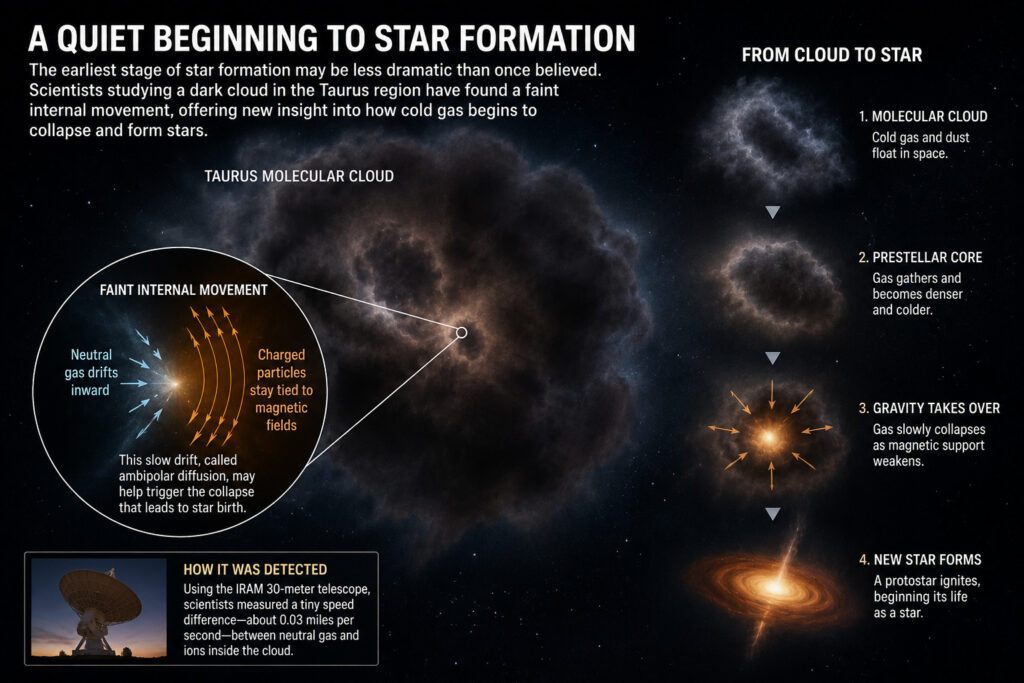
Star formation may begin with an almost invisible movement of gas inside a quiet cloud thousands of light-years from Earth. While studying a dense region called L1544 in the Taurus molecular cloud, astronomers detected a tiny gas motion that could reveal one of the earliest stages of stellar birth.
The discovery comes from researchers at Kyushu University in Japan and the Max Planck Institute for Extraterrestrial Physics in Germany. Scientists believe the findings could answer one of astronomy’s longest-standing questions about how new stars emerge.
How Star Formation Begins
Long before a star starts shining, star formation begins inside cold clouds of gas and dust. Scientists call these regions prestellar cores, where temperatures remain only a few degrees above absolute zero.
Astronomers know gravity slowly pulls material inward. However, powerful magnetic fields resist that collapse and slow the process. Researchers have struggled for decades to understand how gravity finally overcomes those magnetic forces.
The latest observations suggest the answer lies in a slow separation between charged particles and neutral gas.
Scientists Detect Tiny Gas Movement
Using the IRAM 30-meter radio telescope, researchers measured two different types of particles inside the cloud.
They discovered that neutral gas moved slightly faster than charged particles.
Although the difference measured only about 0.03 miles per second, it closely matches a process known as ambipolar diffusion.
In simple terms, neutral gas slowly passes through magnetic fields while charged particles remain trapped. As this continues, the magnetic field gradually weakens, allowing gravity to collapse the cloud and create a newborn star.
Scientists predicted this process many years ago, but until now they had not found such convincing observational evidence.
Why This Discovery Matters
Understanding star formation helps explain how galaxies evolve and how planetary systems eventually develop.
Stars create many of the heavy elements that later become part of planets and living organisms. Learning how they form gives scientists a better understanding of the universe itself.
Researchers now plan to examine other prestellar clouds to determine whether the same gas movement appears elsewhere in space.
If future observations confirm these findings, astronomers could finally understand one of the earliest stages of star formation, bringing them closer to explaining how cold clouds become brilliant new stars.